LA's Mansion Tax Reset Its Thresholds on July 1. Here's What Actually Changed.
Christina Kim · 20 Jul 2026 · 6 min read
Three and a half years in, Measure ULA has stopped being news and started being infrastructure. It survived three court challenges. It crossed a billion dollars in collections. And on July 1, its thresholds quietly moved again — the annual inflation adjustment that most people selling in Los Angeles never think about until an escrow officer hands them a number.
Here's where things stand, and why the next four months matter more than the last four.
The new numbers
For any transaction closing after June 30, 2026, the tax applies at:
- 4% on sales of $5,400,000 or more, up to $10,899,999
- 5.5% on sales of $10,900,000 and above
The prior brackets were $5,300,000 and $10,600,000. The adjustment is routine, but the effect on a specific deal is not. A property that would have triggered ULA in June may sit below the line in August, and vice versa.
Two things about this tax get misunderstood constantly, so they're worth stating plainly.
It is not a mansion tax. The nickname stuck because the campaign used it, but Measure ULA applies to every property class in the City of Los Angeles — apartment buildings, strip retail, industrial parcels, raw land. A twelve-unit building in Koreatown trading at $6.2 million owes the same 4% as a house in Bel-Air at the same price. Commercial and multifamily transactions have carried a substantial share of the burden since day one.
It is levied on gross price, not profit. If you bought at $5.6 million in 2021 and sell at $5.5 million today, you have lost money on the property and you still owe $220,000 to the city. The tax has no relationship to whether the transaction made anyone anything.
The cliff is the whole story
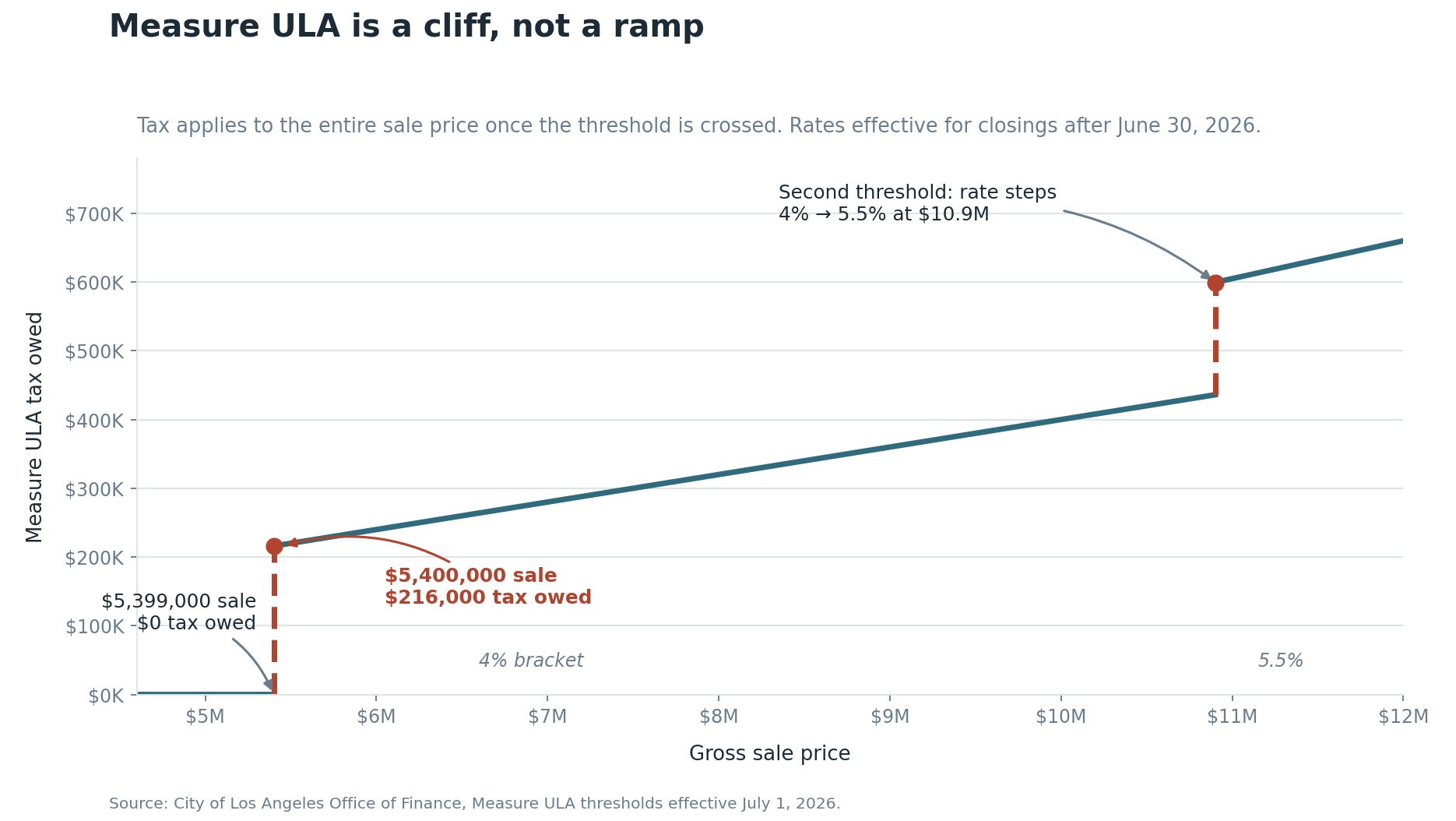
Because ULA applies to the entire sale price rather than the amount above the threshold, the line is a wall, not a ramp.
Sell at $5,399,000 and you owe nothing. Sell at $5,400,000 and you owe $216,000. That one-thousand-dollar difference in price costs the seller a fifth of a million dollars.
This is not a theoretical problem. UCLA research found that since ULA took effect, the likelihood of a property in Los Angeles selling above $5 million dropped by roughly 55%. Sellers price below the line, split parcels, hold, or move the transaction out of city limits. The band immediately above each threshold has thinned dramatically.
If you own something that might appraise anywhere near $5.4 million, the pricing conversation has to start with the threshold and work outward. It is the single largest line item in the transaction.
What the money has done — and hasn't
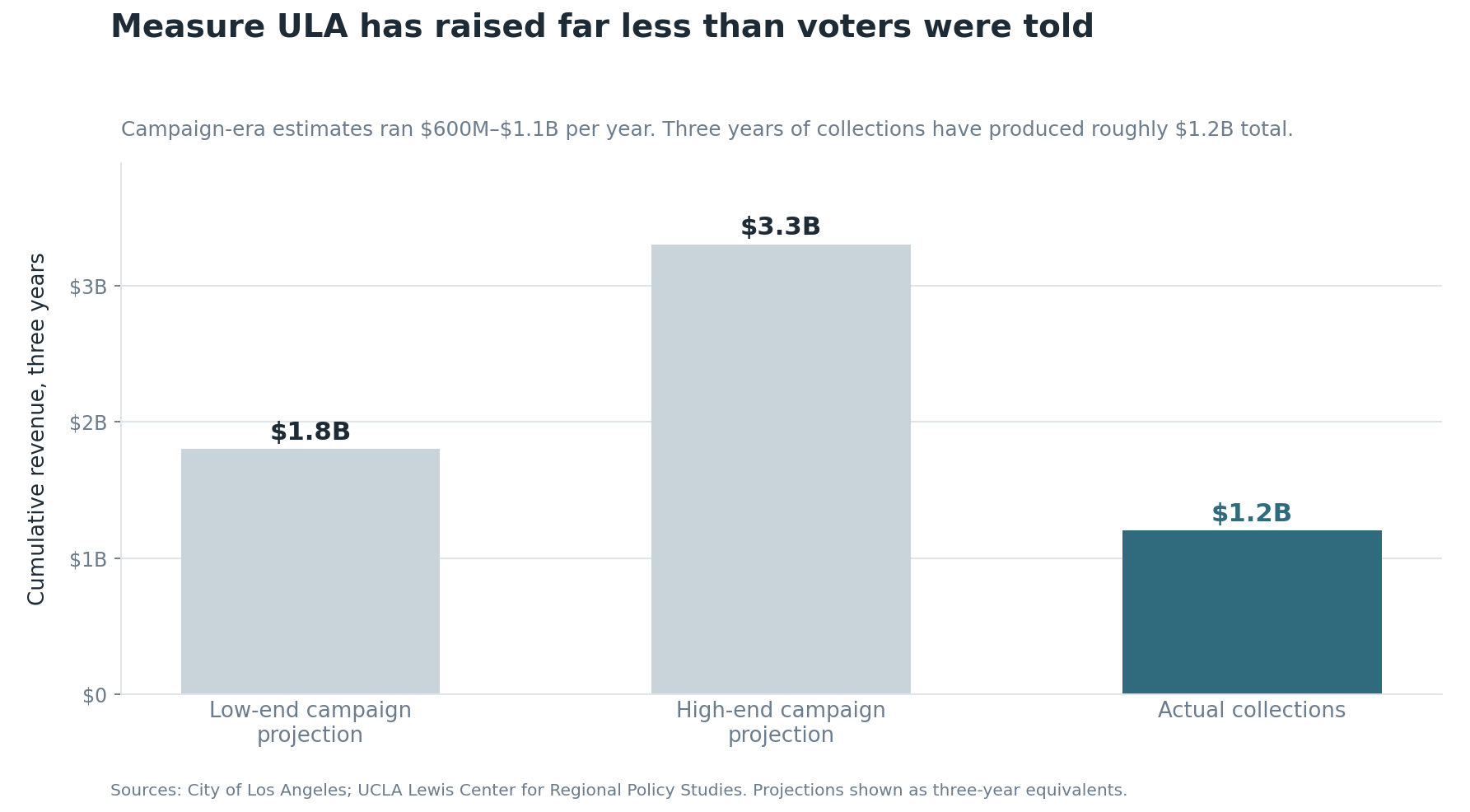
In January, the city reported that Measure ULA had passed $1 billion in total revenue since collections began in April 2023. By May 2026 the figure was closer to $1.2 billion over three years.
That sounds like a lot. Measured against what voters were told, it isn't. Projections at the time of the 2022 election ran between $600 million and $1.1 billion per year. Three years of collections have delivered roughly what a single strong year was supposed to produce. The UCLA Lewis Center has attributed the shortfall largely to the transactions that stopped happening — a tax that discourages the activity it taxes collects less than a static model predicts.
The harder finding, and the one that has driven the political fight, concerns housing production. Research from UCLA and RAND estimates that ULA has reduced new housing construction in Los Angeles by approximately 1,910 units per year, an 18% drop from pre-election levels, with a steeper roughly 30% decline in large apartment projects. Because affordable units are frequently bundled into market-rate developments through density bonus programs, the city loses subsidized apartments alongside the market-rate ones.
Supporters of the measure dispute the magnitude and point to what the revenue has funded: homelessness prevention, tenant legal defense, and acquisition of existing buildings for affordable housing. A study commissioned by United to House LA in March of this year reached considerably more favorable conclusions. This remains genuinely contested ground, and anyone claiming the question is settled is selling something.
The reform that died in committee
Councilmember Nithya Raman spent much of the past year assembling a fix aimed at the production problem specifically: a 15-year ULA exemption for newly constructed multifamily, commercial, and mixed-use buildings. The logic was straightforward — if the tax is suppressing construction, stop applying it to construction.
On July 6, the City Council declined to place the rewrite on the ballot. The measure is dead for this cycle. Whatever the merits, the practical result is that ULA applies to new apartment buildings exactly as it did before, and the developers who have been sitting on entitled sites near the threshold have no relief coming from City Hall.
The bigger threat is on the November ballot
While Los Angeles was deciding not to amend its own tax, the Howard Jarvis Taxpayers Association was gathering signatures for a statewide measure aimed at the November 2026 ballot. If it qualifies and passes, it would sharply restrict the ability of more than two dozen California cities to impose elevated real property transfer taxes — Los Angeles chief among them.
This matters because the courts are no longer a viable route for opponents. The legal record is one-sided:
- Los Angeles County Superior Court dismissed the original challenge in 2023
- The California Court of Appeal, Second District, affirmed that dismissal
- The federal case brought by Newcastle Courtyards was dismissed in September 2023, and the Ninth Circuit disposed of the appeal in November 2024
Three losses. The measure is settled law unless voters change it. That makes November the only live question, and it is a question about the ballot box rather than the bench.
What sellers should be doing now
Know your number before you price. Not a Zestimate — an actual broker price opinion with the ULA threshold marked on it. If the range straddles $5.4 million, that fact reshapes the entire strategy.
Confirm who pays in writing. Convention in Los Angeles is that the seller covers the ULA tax, but convention is not law. It is a negotiated term. Escrow instructions should specify, separately and explicitly, who bears the city transfer tax, the county transfer tax, and the ULA tax. Ambiguity here is expensive.
Check whether an exemption applies. They are narrow but real: qualifying 501(c)(3) organizations that have held their IRS determination for at least ten years and hold under $1 billion in assets, government agencies, transfers in and out of trusts where beneficial ownership does not change, interspousal transfers in dissolution, bankruptcy-ordered transfers, and deeds in lieu of foreclosure. If you think you might qualify, get it confirmed by counsel well before closing rather than discovering it at the signing table.
Watch the ballot. If the Howard Jarvis measure qualifies, sellers holding property near the threshold face a real timing decision this fall. There is no way to know how that vote goes, and anyone who tells you otherwise is guessing. But it belongs in the calculation.
If you own property in Los Angeles anywhere near these thresholds and want to talk through what it means for your specific situation, I'm happy to walk through the numbers with you.



Thinking about a move in LA?
Whether you're buying, selling, or just curious what your home is worth — start with a conversation. No pressure, no obligation.
Book a consultation